


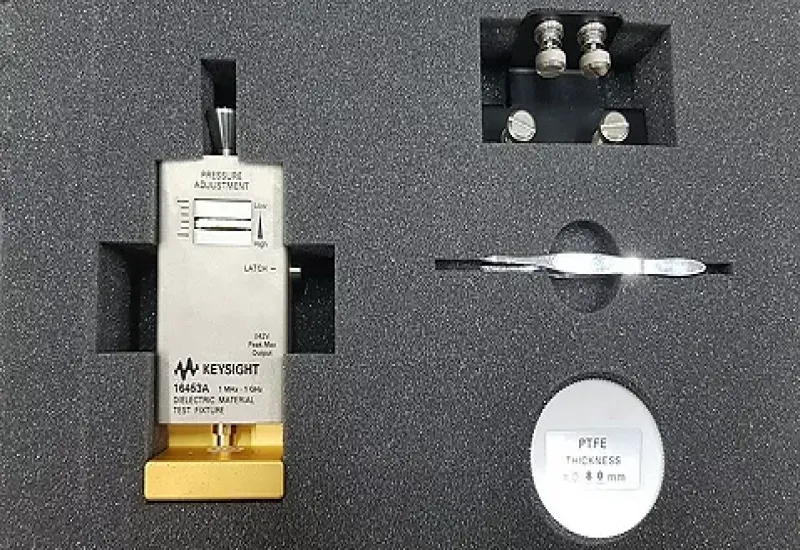
Keysight 16453A fixture rental in Monterrey, Nuevo León
We rent the Keysight 16453A Dielectric Material Test Fixture, for characterizing the dielectric properties of solid materials. It measures relative permittivity, complex permittivity and dielectric losses with the parallel plate method, and is used to evaluate the electrical behavior of materials used in electronics, electrical applications, RF, telecommunications and advanced manufacturing.
The Keysight 16453A typically operates from 1 MHz to 1 GHz and works with compatible impedance analyzers, on solid samples with a smooth surface.
What the Keysight 16453A is
It is a test fixture for solid dielectric materials that uses the parallel plate method. The sample is placed between two electrodes and forms a capacitive structure; the measured electrical response is used to determine the dielectric properties of the material.
Its flexible electrode conforms to the surface of the sample and does not need the manual parallelism adjustment that other parallel plate fixtures require. This simplifies preparation and helps test repeatability.
Dielectric properties that can be studied
- Relative permittivity (εr)
- Complex permittivity
- Real part of permittivity (ε’)
- Imaginary part of permittivity (ε”)
- Dissipation factor
- Dielectric loss tangent (tan δ)
- Dielectric behavior as a function of frequency
These measurements matter when the material will be used as an insulator, substrate, encapsulant, RF circuit component or material for high-frequency applications.
Frequency range from 1 MHz to 1 GHz
The 16453A measures from 1 MHz to 1 GHz. This range shows how the dielectric properties of the material change as frequency increases, because its response can vary widely due to different polarization and loss mechanisms. A single-point measurement of the dielectric constant may not be enough in electronic or RF applications.
The frequency sweep gives a more complete picture and can reveal variations that affect the design of circuits, insulation, encapsulation, sensors or radio frequency components.
Materials that can be evaluated
The fixture is intended for solid dielectric materials with smooth surfaces and uniform thickness. Candidates:
- Ceramics
- PTFE and other polymers
- Resins
- Engineering plastics
- Insulating materials
- Laminates
- Materials used in electronics
- Dielectric substrates
- Encapsulation materials
- Dielectric films and sheets compatible with the fixture dimensions
For the 16453A, Keysight specifies samples with a thickness of approximately 0.3 to 3 mm and a diameter of 15 mm or more, for smooth sheets.
Why measure permittivity
Electrical permittivity is a fundamental property when a material interacts with an electric field. At high frequency, knowing it allows materials to be designed and selected more precisely.
RF and microwave circuit design
The dielectric constant of a substrate influences signal propagation and the impedance of transmission structures. It helps in selecting materials for PCBs, RF circuits and microwave applications.
Evaluation of insulating materials
It allows materials to be compared to determine which have the most suitable dielectric properties for an application.
Material development and control
Manufacturers and engineers can compare formulations, production lots or material modifications.
Electronics and encapsulation
The materials around electronic components can exhibit losses and permittivity variations that affect the electrical behavior of the assembly.
Research and development
Measurement as a function of frequency generates experimental data for research, material design and validation of electromagnetic models.
Parallel plate method
The material under test sits between the electrodes. The analyzer measures the electrical response of the structure and the system uses the sample parameters to calculate its dielectric properties. To obtain reliable results, you must control:
- Actual sample thickness
- Sample dimensions
- Surface flatness
- Surface cleanliness
- Pressure or contact between electrodes
- System calibration
- Frequency range
- Test signal level
Calibration uses the sample connection plane as its reference, which reduces the effects of the fixture’s electrical residuals.
Compatibility with Keysight systems
The 16453A is used with compatible Keysight impedance analyzers. Keysight documents its use with systems such as the E4991A/E4991B, depending on the configuration and installed options.
In systems with Keysight N1500A Materials Measurement Software, the 16453A is part of the parallel plate permittivity measurement configurations.
Before renting, verify the available analyzer, the software options, the connections and the accessories your test requires.
When renting makes sense
We rent the Keysight 16453A to laboratories, engineering departments, manufacturers and research centers that need dielectric characterization without buying the fixture. It is useful for:
- Research and development projects
- Validation of new materials
- Supplier comparison
- Development of dielectric materials
- Engineering tests
- Characterization of materials for RF
- Evaluation of electronic substrates
- Prototype validation
- Temporary laboratory projects
Material characterization with us
In addition to renting the fixture, we characterize materials with specialized instrumentation, to complement dielectric measurements with other techniques depending on the sample and the parameters you need.
The method depends on frequency, geometry, thickness, homogeneity, expected permittivity and type of material. Our team can review the characteristics of your sample before defining the test configuration.
To check availability, tell us the material to be measured, sample dimensions and thickness, frequency range and available analyzer, and we will review the compatibility of the configuration.
Main specifications
| Feature | Keysight 16453A |
|---|---|
| Type | Dielectric material test fixture |
| Method | Parallel plate |
| Frequency | 1 MHz – 1 GHz |
| Material | Dielectric solids |
| Sample thickness | 0.3 – 3 mm |
| Sample diameter | ≥ 15 mm |
| Parameters | Permittivity and dielectric losses |
| Electrode | Flexible |
| Application | Dielectric characterization |
These specifications are based on official Keysight documentation.
Sale, accessories and equipment details
We offer rental or sale of test kits for dielectric material and various test accessories.
With the HP 16453A you can eliminate stray capacitance when measuring the dielectric constant of solid materials with the parallel plate method.
The 16453A is designed for accurate measurement of dielectric constant and loss tangent on the E4991A/4291A/B. The parallel plate method sandwiches the material between two electrodes to form a capacitor. The E4991A/4291A/B measures the capacitance created from the device, and the option 002 firmware calculates the relative complex permittivity, as described in the 16451B. With the 16451B an adjustment is required to ensure parallel electrodes; with the 16453A it is not, because its flexible electrode adjusts automatically to the surface of the material.
Features
- Frequency: 1MHz to 1GHz
- Sample size (smooth sheets only): thickness of 0.3 mm to 3 mm; diameter ≥ 15 mm