


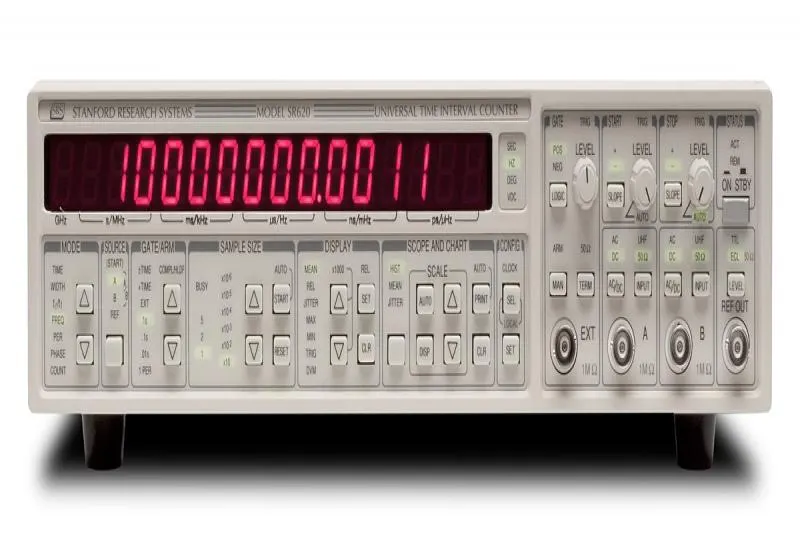
SR620 counter with rubidium timebase
The SR620 time interval counter makes virtually all the time and frequency measurements required in a laboratory or ATE (Automated Test Equipment) environment. Its single-shot timing resolution and low jitter make it the counter of choice for almost any application.
Measurements
The SR620 measures time interval, frequency, pulse width, rise and fall time, period, phase and events.
- Time intervals with 25 ps rms resolution.
- Frequency from 0.001 Hz to 1.3 GHz.
- Gate selection from 1 period to 500 seconds.
- Up to 11 digits of frequency resolution in one second.
It is suitable for everything from short-term phase-locked loop jitter to the long-term drift of atomic clocks. All measurement modes support a wide variety of trigger options.
Live graphic displays
Unlike conventional counters with numeric-only displays, the SR620 shows live graphs of the results. There are three formats: a histogram with the distribution of values from a set of measurements, a strip chart of the mean values of successive measurements, or a strip chart of jitter values (standard deviation or Allan variance). Up to 250 strip chart points or histogram bins can be displayed.
Histograms and strip charts can be viewed on any oscilloscope with an X-axis input, or plotted on an HP-GL compatible plotter or a dot matrix printer. Cursors let you read the value of any data point, and the autoscale and zoom functions make viewing easier.
Statistical calculations
The SR620 can make single-shot measurements or calculate the statistics of a set of measurements, with sample sizes from one to one million. It automatically calculates the mean, standard deviation or Allan variance, minimum and maximum of each set.
Reference output
The front-panel REF output delivers a precision 50% duty cycle square wave (1 kHz). It can serve as a source of start or stop pulses in any measurement mode. For example, the length of a cable connected between REF and input B is determined by measuring the delay time between REF and B.
Built-in DVMs and analog outputs
Two DVM inputs on the rear panel measure DC voltages with 0.3% accuracy (± 20 V DC range). The values can be read through the interfaces or shown on the front panel.
Two 0 to 10 V DAC outputs deliver voltages proportional to the mean and the jitter of the sample. They can drive strip chart recorders or be set to fixed or scanned output voltages.
Automatic calibration
A built-in autocalibration routine nulls the insertion delays between the start and stop channels and compensates for the differential nonlinearities of the analog time measurement circuits. It takes about two minutes and should be run every 1000 hours of operation.
10 MHz reference
The timebase affects the resolution and accuracy of measurements. SRS offers a standard timebase with an aging coefficient of 1 × 10⁻⁶ / year, or an optional oven-controlled oscillator timebase with aging of only 5 × 10⁻¹⁰ / day and approximately an order of magnitude better short-term stability. A rear-panel input accepts any external 5 MHz or 10 MHz source as a timebase.
Computer interfaces
The standard GPIB (IEEE-488.2) and RS-232 interfaces allow remote control. All functions and setup menu settings are accessible through the interfaces. A fast binary dump mode sends up to 1400 measurements per second to a computer. A parallel printer port allows printing directly from the instrument, and plotter outputs are delivered in HP-GL format. The last 256 characters transmitted through the interfaces can be viewed on the front panel for debugging.