


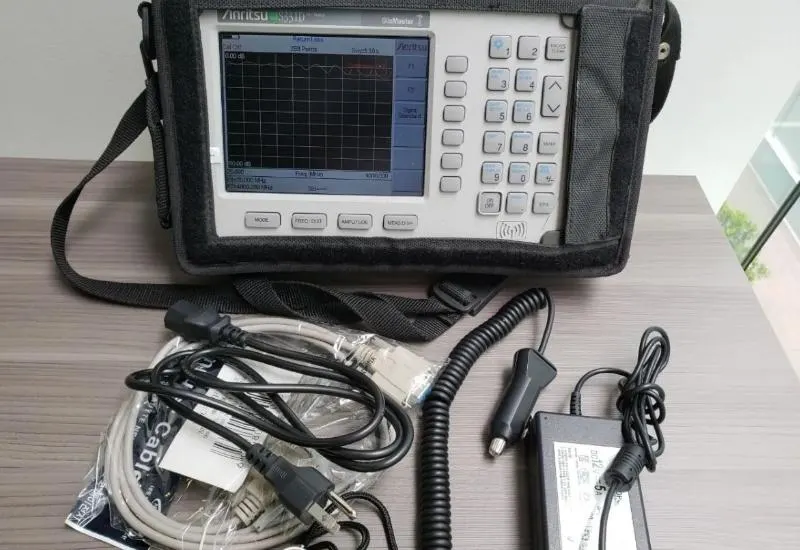
Cable and antenna analyzers in Monterrey
We perform measurements and generate professional reports. We also rent equipment from brands such as Anritsu, Advantest, Tektronix, Agilent Keysight and Rohde & Schwarz. We analyze interference and supervise cable and antenna installations at radio frequencies up to 26.5 GHz. We are located in Monterrey, Mexico.
The basic tool of our technicians is the portable cable and antenna analyzer (SWR meter). With it they analyze system behavior, locate faults, characterize the system and maintain a complete transmission system. The fundamental measurements are:
- Return loss (RL)
- SWR
- Cable loss
- Fault location (DTF)
- Time domain reflectometry
The analyzers we use employ FDR (Frequency Domain Reflectometry) technology. With this technique the antenna system is analyzed in its working band and changes and degradation, large or small, are detected. Preventive maintenance can then be applied before problems become severe. In addition, the antenna is tested in its exact working band, with the signal passing through the corresponding frequency-selective devices, such as filters, quarter-wave lightning arrestors or the duplexers common on cellular system antennas.
The main advantage of FDR over TDR (Time Domain Reflectometry) is that the energy in the working band is much higher. This gives greater sensitivity and a better chance of detecting small faults before they grow.
Return loss and SWR (VSWR)
For the field technician who installs, tunes or maintains antenna systems, the key measurement is RL or SWR. They indicate the match of the system and whether it meets the specifications defined by the operator. If the results are not adequate, it is very likely that the system will not work well and that the associated base station will have problems affecting its subscribers.
A poorly matched antenna reflects RF energy that is then not available for transmission and returns to the transmitter. That energy distorts the signal and affects the transmitted power and the coverage area of the base station.
For example, a system with a return loss of 20dB is very efficient: only 1% of the power is reflected and the remaining 99% is transmitted. With a loss of 10dB, the station is inefficient, because 10% of the signal is reflected. Each system has its own characteristics, but a return loss of 15dB or better is an acceptable value for any system.
An antenna system can fail for many reasons. The most typical are poorly installed connectors, damaged cables, overtightened clamps and defective antennas.
Both RL and SWR show the match of the system, but in different ways. Return loss indicates the ratio between reflected power and incident power (Tx output), in dB. It is the most widely used measurement because its logarithmic presentation makes it easy to compare two very different measurements. SWR is represented on a linear scale.
The usual RL scale runs from 0 to 60dB. 0 corresponds to a short or an open circuit, and 60 to a perfect match.
Distance to fault (DTF)
To verify an antenna system, two measurements are needed: RL / SWR or VSWR, and cable insertion loss. The first predicts the overall behavior of the system; the second indicates the drop in signal level. If the result of either is not as expected, a DTF measurement helps review the system and locate the causes.
The DTF measurement is strictly an aid: it allows you to compare data and monitor changes in the time domain, locate discontinuities and measure how far they are from the measurement point.
Electronic analysis equipment rental
Creativeit in Monterrey offers time in an RF test and analysis laboratory, where we test and, if necessary, tune antennas, amplifiers, filters or any device or module. The laboratory is air-conditioned to give maximum stability to the test equipment and the results.
This service is useful for companies that:
- Need to test one or more items, but do not want to pay the high costs of a large laboratory.
- Do not want to hire or rent expensive equipment.
- Do not have technicians familiar with the equipment.
Antennas often come with highly exaggerated specifications. Testing them is worthwhile if you buy many of them or want to know their real characteristics.
There is a wide range of test equipment, mainly RF: RF power analyzers, vector network analyzer, signal generators with digital modulation, oscilloscopes and spectrum analyzer up to 26.5 GHz.
We also have a thermal imaging camera, dynamic and vibration analyzers, audio analyzers, and optical equipment such as power meters and OTDRs, in case you need other analyses.
Send us an email with what you want to test. Antennas, attenuators, cables, couplers, oscillators, terminations, connectors, filters: everything can be tested. We will send you the quote as soon as possible.
Connectors
We handle most types of RF connectors: N, BNC, 3.5 mm, SMA, APC-7, reverse SMA, PL-259, 7.16 and WR159 waveguide. We use calibration and verification kits to obtain accurate results.
Power supply
For power requirements we have several programmable supplies of 0-80 Volts and up to 50 amps.
Report and turnaround
You tell us the tests you want to run and the format, which can range from a pass / fail label to a 100-page report. If what you require can be done, we will estimate the total time, which includes the tests and preparing the report in the format you request. If you wish, we will also show step by step what we do while measuring.