


Signal and function generators in Monterrey
We have several types of signal, function and sweep generators (sweepers) up to 26.5GHz, for rent or sale. We carry professional brands such as Tektronix, Agilent, Rohde & Schwarz and Anritsu. AM, FM and digital FSK modulation. Equipment in immediate INVENTORY.
We have tutorials on our YouTube channel.
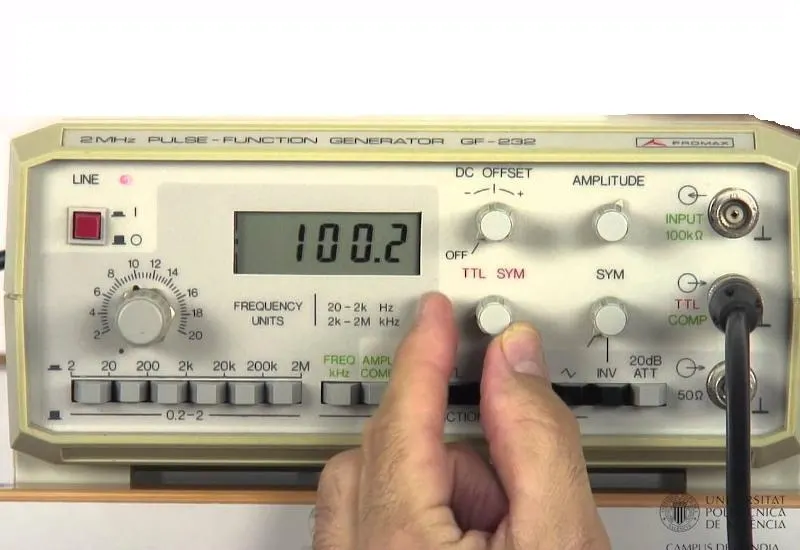
A function generator produces waveforms for testing and diagnostics: it is used to excite systems and analyze their behavior in practice.
A signal generator, function generator or waveform generator is an electronic laboratory device that generates periodic or non-periodic signal patterns, analog or digital.
There are two types of generators: analog and digital. Analog generators produce the basic types of electrical waves: sine, square and triangular. Digital generators can produce any type of wave.
Common uses
- Creating signals: signals created from scratch to simulate, stimulate and test different circuits and devices.
- Replicating signals: an anomaly, an error or a signal acquired by an oscilloscope can be replicated with a function generator in the laboratory, to vary its parameters and analyze it in a controlled environment.
- Generating signals: ideal signals or known functions, to use as a reference or as an input signal in tests.
What is an oscilloscope?
An oscilloscope is a graphical display device that shows electrical signals varying over time. The vertical axis (Y) represents voltage and the horizontal axis (X) represents time.
What can we do with an oscilloscope?
- Determine the period and voltage of a signal directly.
- Determine the frequency of a signal indirectly.
- Determine which part of the signal is DC and which is AC.
- Locate faults in a circuit.
- Measure the phase between two signals.
- Determine which part of the signal is noise and how it varies over time.
What types of oscilloscopes are there?
Electronic equipment is divided into analog and digital. The former works with continuous variables and the latter with discrete variables. For example, a record player is an analog device and a Compact Disc is a digital device.
Oscilloscopes can also be analog or digital. Analog oscilloscopes work directly with the applied signal: once amplified, it deflects an electron beam vertically, in proportion to its value. Digital oscilloscopes first use an analog-to-digital (A/D) converter to store the input signal and then reconstruct that information on the screen.
Sampling methods
For slowly varying signals, digital oscilloscopes can gather more points than are needed to reconstruct the signal on the screen.
Real-time sampling with interpolation
Oscilloscopes use interpolation to display signals faster than their sampling rate. There are basically two types:
- Linear: connects the sampled points with lines.
- Sinusoidal: connects the sampled points with curves according to a mathematical process; intermediate points are calculated to fill the gaps between the actual sample points. This makes it possible to display signals with great accuracy from relatively few samples.