


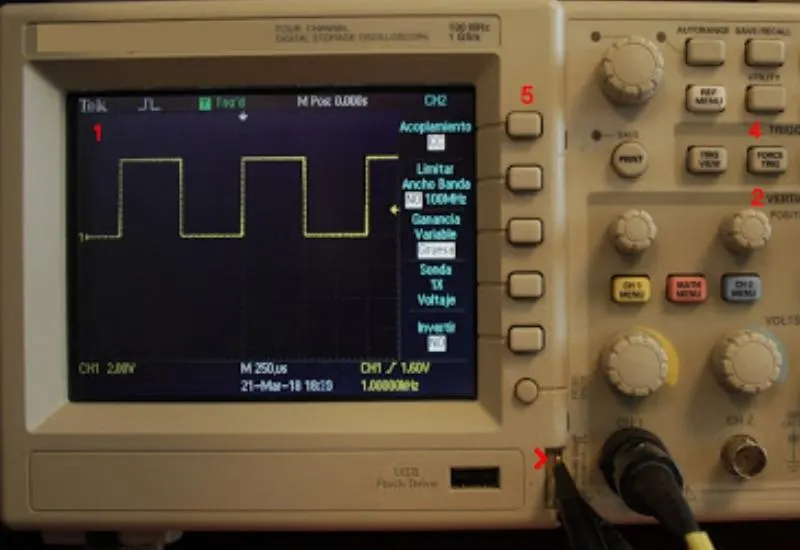
Differential oscilloscope probes and 1X 10X passive probes
We have high-voltage, ground-isolated differential probes. Equipment in inventory.
A differential probe makes it possible to measure safely on channels whose ground references differ from one another. On non-isolated oscilloscopes the grounds are common and tied to the oscilloscope’s earth ground. To measure in those cases, the channel grounds must be separated from each other and from the ground connector, and that is what differential probes do.
Test probes and noise
To measure, it is essential to be able to connect the probe to the point of interest. An ideal probe would also make that connection easy.
On miniature circuits, such as high-density surface-mount technology (SMT) boards, connection is made easier by miniature probe heads and tip adapters designed for that type of device. These probes are too small for industrial power circuits, where high voltages and longer reference leads are common. Power applications call for larger probes with greater safety margins.
There are always noise sources in the environment, such as fluorescent tubes and motor-driven ventilation equipment. They can induce noise in nearby circuits and cables, and that noise adds to the original signal. This is why a plain wire is not used as a test probe: it is susceptible to noise.
An ideal probe is immune to noise sources, so the signal it delivers to the instrument adds no noise beyond what was already present at the test point.
Alternating currents
Alternating current (AC) is electric current whose magnitude and direction vary cyclically. The most widely used waveform is the sine wave, because it allows more efficient energy transmission. Certain applications use other periodic waveforms, such as triangular or square waves.
Alternating current is the form in which electricity reaches homes and businesses. Audio and radio signals carried over electrical wiring are also alternating currents; in those uses, what usually matters most is transmitting and recovering the information encoded on the AC signal.
AC generators
A simple generator without a commutator produces an electric current that reverses direction as the armature turns. This type of current is advantageous for transmitting electric power, so most electric generators are of this type. Low-speed AC generators are built with up to 100 poles, to improve their efficiency and reach the desired frequency more easily.
Alternators driven by high-speed turbines are usually two-pole machines. The frequency of the current from an AC generator equals half the product of the number of poles and the number of armature revolutions per second.
Oscilloscope probes
Measuring small or high-frequency signals with an oscilloscope can be difficult. Besides an oscilloscope with good functions, you need good probes, which are very useful for measuring the signal accurately.
The right probe range must be chosen carefully; otherwise it will be impossible to measure high-speed signals correctly in the time domain.
Oscilloscope probes fall into six categories: passive, active, current, optical, high-voltage and differential.