


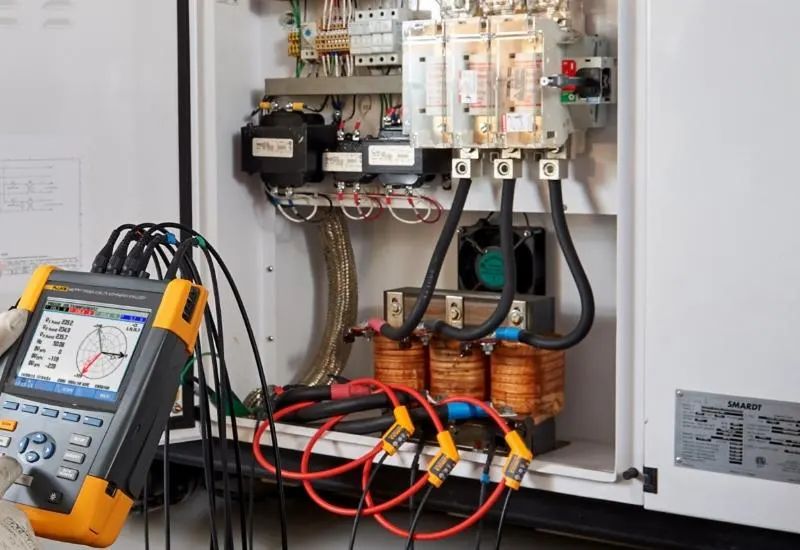
Harmonic analysis
We have the Fluke 435 II for power quality analysis and harmonic measurements on the electrical network. We can review power up to the 50th harmonic.
THD, or total harmonic distortion, is the sum of the power of the harmonics divided by the power of the fundamental. It is one of the most important facets of power quality analysis. Our equipment shows the THD, the current and voltage or power waveforms, and the harmonics of these three separately.
Effects of harmonics on the electrical network
- Increase in the power to be carried, with a worse network power factor.
- Nuisance tripping of circuit breakers.
- Conductor overloads.
- Vibration and overloads in machines.
- Instability in the electrical system.
- Malfunction of protection relays.
- Decrease in capacitor impedance.
- Disturbances in control equipment.
- Erroneous readings in measuring equipment.
Electric utilities are reviewing penalties for industrial installations that generate harmonics, just as they do for those that generate reactive power.
What a harmonic is
Standard UNE-EN 60150:1996 defines harmonic voltage as a sinusoidal voltage whose frequency is an integer multiple of the fundamental frequency of the system supply voltage.
The French mathematician Fourier established that “any periodic signal, however complex, can be decomposed into a sum of sinusoidal signals whose frequency is a multiple of the fundamental or reference frequency”.
Harmonics are generated by nonlinear loads. When connected to the sinusoidal AC network, they draw nonlinear currents whose amplitude and frequency depend on the deformation of the current wave when a sinusoidal voltage is applied. These nonlinear loads are usually periodic.
Importance of the third harmonic
The fundamental wave has an amplitude equal to three times that of the third harmonic, and both reach their peak value at the same instant. The third harmonic is an electrical multiple of the fundamental and has zero sequence. For this reason, in the 4-wire three-phase system (A, B, C and N), it circulates in a loop with the 3 phases through the neutral (N). The same happens with the sixth, the ninth, and so on.
Importance of the fifth harmonic
The fifth harmonic, unlike the third, is not an electrical multiple of the fundamental, so it travels through the three phases A, B and C. It is the first harmonic that affects capacitors and the three-phase system, as do the seventh, the eleventh, and so on.
The third and fifth will be the most important when determining power factor correction in industrial installations, because the capacitors must be installed forming passive (L-C) filters.
The IEEE std 519-1992 standard sets the limits for THD (total harmonic distortion) and TDD (total demand distortion).